📰 Exclusive Crypto News & Analysis: Stay ahead with the latest developments in the cryptocurrency and blockchain space.
📈 Market Update: Real-time price movements, technical analysis, and trading signals.
Galaxy Digital’s Head of Firmwide Research Alex Thorn cut the firm’s estimated probability of CLARITY Act passage in 2026 from 60% to 50% on June 26, citing a narrowing Senate calendar and intensifying competition for floor time, not unresolved policy disputes.
The downgrade marks the second directional cut in weeks, pulling the odds back to levels last seen in April after a brief surge to 75% following the Senate Banking Committee markup in May.
The context matters for anyone tracking crypto regulation and market structure legislation heading into the second half of 2026. A bill that passed the House 294-134 on July 17, 2025, with 78 Democrats crossing the aisle, is now stalling not on substance but on scheduling, and the window is closing fast.

Thorn’s note framed the issue plainly: the shortening calendar and growing competition for floor time are the primary drivers, with a July vote still possible but the path to 60 Senate votes increasingly unclear.
Discover: The Best Token Presales
Clarity ACT: Senate Adjourned Until July 13, Leaving Weeks Before the August Recess
The structural constraint is straightforward. The US Senate adjourned until July 13, and the August recess creates a hard backstop that compresses meaningful floor time to roughly two to three weeks. Senate Majority Leader John Thune secured unanimous consent for the adjournment with no objection, meaning the chamber has already consumed time that the CLARITY Act needed.
The Banking Committee and Agriculture Committee have not yet released a merged bill text, a prerequisite for any floor vote. Until a unified Senate draft is published, Thune cannot schedule floor consideration, and without an early July scheduling commitment, the bill slides to September.
That is not a soft deadline; September puts crypto legislation 2026 directly into midterm election season, where bipartisan cooperation on complex market structure bills has historically collapsed.
The Senate requires 60 votes for CLARITY Act passage, a threshold that demands meaningful Democratic buy-in. Competing priorities, FISA legislation, the National Defense Authorization Act, Trump’s housing bill tied to the SAVE Act, and a backlog of nominations, are all positioned ahead of crypto market structure in the queue.
Galaxy’s scenario framework is specific. If a unified Senate text is published around July 4, as Senator Cynthia Lummis has indicated is the target, and Thune commits to a floor vote before the recess, Thorn said odds could move back above 60%. The policy building blocks are largely in place: the bill establishes SEC/CFTC jurisdictional boundaries, introduces a mature blockchain test for securities classification, and extends federal AML obligations to digital commodity intermediaries for the first time.
If neither a merged text nor a scheduling commitment materializes before mid-July, Galaxy’s framework points to another downgrade. Ethics provisions, specifically conflict-of-interest rules for government officials’ crypto holdings, remain unsettled after a Van Hollen amendment failed 11-13 in committee, and Senators Ruben Gallego and Cory Booker have both treated enforceable ethics rules as a condition for their support. That is not resolved; it is deferred.
Parallel regulatory timelines in 2026 have consistently shown that prediction markets reprice faster than institutional analysts when legislative momentum stalls.
Polymarket traders currently put CLARITY Act passage at 41%, nine points below Galaxy’s 50%, having fallen from 82% in February as the Senate calendar deteriorated. That gap does not invalidate Thorn’s estimate, but it reflects how sharply informed public sentiment has moved against the July timeline.
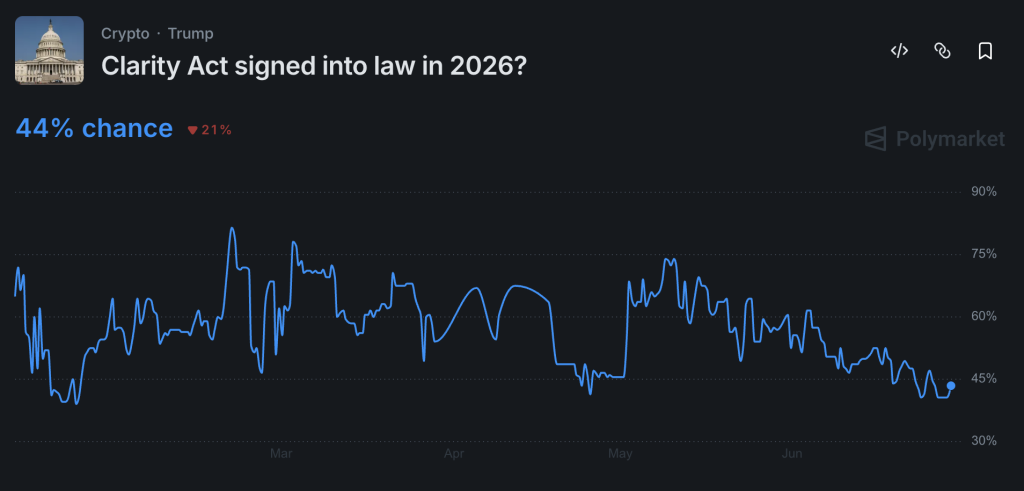
The divergence is worth holding. Galaxy is pricing in the possibility that Lummis’s July 4 text target holds and leadership acts; Polymarket is pricing in the base rate of Senate inaction on complex legislation under a compressed calendar.
The CLARITY Act’s failure to clear the Senate this year would not be a minor procedural setback. Senator Lummis has warned that a miss in 2026 risks pushing market structure legislation to 2030 or beyond, given the probability of a changed chamber composition after November.
For institutional participants waiting on the SEC/CFTC jurisdictional split the bill codifies, each week of delay extends compliance uncertainty across the digital asset intermediary sector. The next hard signal to watch: publication of the merged Senate text. Its presence or absence in the first two weeks of July will determine whether Galaxy’s 50% holds or gets cut again.
Discover: The Best Crypto to Diversify Your Portfolio
Don’t Miss Out on Our $1,000 USDT Airdrop on ByBit
The post Here’s Why Galaxy Just Slashed Clarity Act Odds In Half appeared first on Cryptonews.
💡 Pro Tip: Bookmark our site for daily insights, market predictions, and expert trading strategies.
🔗 Explore More: Check our sections for in-depth guides, exchange reviews, and blockchain technology deep-dives.