Illinois Governor JB Pritzker Greenlights Crypto Tax of 0.2% on Every Transfer Starting 2027

📰 Exclusive Crypto News & Analysis: Stay ahead with the latest developments in the cryptocurrency and blockchain space.
📈 Market Update: Real-time price movements, technical analysis, and trading signals.
Key Takeaways
- Illinois’ Digital Asset Tax Act imposes a 0.2% levy on crypto transfers effective Jan. 1, 2027, regardless of profit.
- The tax targets brokers earning over $100,000 from Illinois users and is projected to raise about $60 million a year.
- The Crypto Council for Innovation and Illinois Blockchain Association are demanding a repeal before the 2027 start date.
A Tax on Movement, Not Profit
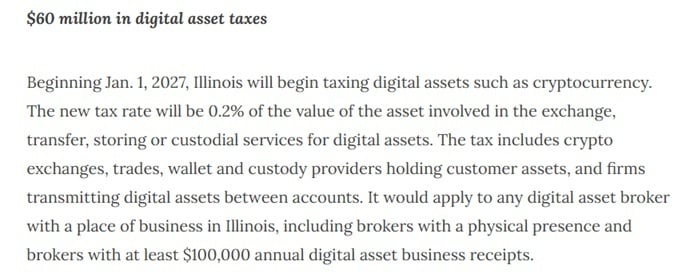
Illinois has become the latest U.S. state to write digital assets directly into its tax code. Governor JB Pritzker signed the Digital Asset Tax Act (DATA) into law in mid-June as part of the state’s roughly $55.9 billion fiscal 2027 budget. The measure introduces a 0.2% privilege tax on a broad set of digital asset activities (including exchanges, transfers, custodial services, and storage) that takes effect on Jan. 1, 2027.
In all of this, the detail that has alarmed the industry quite naturally is how the tax is calculated because, rather than taxing gains, the levy applies to the gross value of each covered transaction. A user who swaps tokens or moves assets through a covered broker would owe the charge on the full amount, even on a losing trade.
As things stand, most tax regimes only reach a profit when an asset is sold; however, Illinois’ new fiscal structure taxes the transaction itself, something that touches routine activities like rebalancing one’s portfolio or shifting coins between platforms.
Who Pays and How Much
The tax falls on digital asset brokers, i.e. firms with a physical presence in Illinois or earning more than $100,000 a year from Illinois customers. Those brokers must list the charge as a separate line item on customer bills, meaning the cost is widely expected to flow through to retail users rather than be absorbed by the platforms. The Illinois Department of Revenue projects the measure will raise roughly $60 million annually.
The law arrives as Washington tightens its own crypto tax net, with Bitcoin.com News reporting earlier this week that a proposed change could limit loss-harvesting strategies by extending wash sale and constructive sale rules to many digital assets (while still providing limited exemptions for certain categories of crypto activity).
Tax advisers have flagged how broadly the Illinois statute could reach and accounting firm BDO described it as a potentially wide-reaching digital asset taxwarning that its definitions could capture more activity than a conventional capital gains regime.
Out-of-state brokers could also owe the tax once they cross the $100,000 revenue threshold, raising compliance questions for national exchanges that serve Illinois residents.
Industry Pushback
The response from advocacy groups has been swift, with the Crypto Council for Innovation and the Illinois Blockchain Association both condemning the law, describing it as the “most punitive digital asset tax in the United States” and calling for a repeal. Critics argue that taxing gross transfer value penalizes ordinary users far more heavily than active traders, since the charge applies even when no money is made.
Supporters of the budget frame the levy differently, presenting it as a modest, narrowly defined revenue source within a multibillion-dollar spending plan. At 0.2%, the headline rate is small, but opponents counter that the cumulative cost mounts quickly for anyone who transacts frequently, because each transfer is taxed in full.
The debate mirrors a broader national tension over how to treat digital assets in state budgets. As more legislatures search for new revenue, the question of whether to tax crypto like property, like a financial transaction, or like a taxable service remains unresolved.
💡 Pro Tip: Bookmark our site for daily insights, market predictions, and expert trading strategies.
🔗 Explore More: Check our sections for in-depth guides, exchange reviews, and blockchain technology deep-dives.