

The creation of the EU-launched digital euro moved a step closer on Tuesday following a vote in a key European Parliament committee.
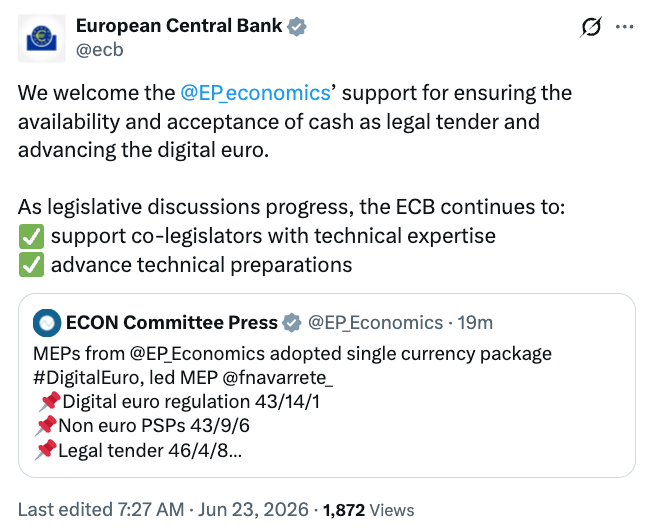
The European Parliament’s Economic and Monetary Affairs Committee (ECON) approved its position on the digital euro package by 43 votes to 14. respectively pending an official announcement on Tuesday.
Fernando Navarrete Rojas, a member of the European Parliament (MEP), said the package “protects the freedom of citizens to choose their payment method”, adding that the digital euro “will complement cash, not replace it”.
The vote marks a key step in shaping the rules for a potential EU central bank digital currency (CBDC) as the European Central Bank (ECB) aims to launch the digital euro in 2029.
Privacy and offline payments at the core
According to the approved project, the digital euro will be issued by the ECB and will function both online and offline.
Online payments will use an account-based system, while offline payments will be made through the device’s local storage, similar to cash in terms of user control.
“Offline functionality will be equivalent to using physical money, as losing the device would mean losing money offline with no way to get it back,” the announcement said.
Source: ECB
The proposal includes privacy-by-design features, including technologies such as zero-knowledge proofs (ZKP) to verify transactions without revealing personal data. “The ECB will not have access to personally identifiable information,” it said.
The digital euro will not pay interest
The project also introduces storage limits to protect financial stability, with limits on how many digital euros people can hold. These limits will be set by the European Commission on the basis of ECB recommendations and will be regularly reviewed.
The currency will not pay interest, and businesses will only be allowed to hold digital euros temporarily to accumulate incoming payments for 24 hours. Businesses will generally have to accept the digital euro, with some exceptions for very small firms and self-employed operators who do not yet accept digital payments.
On the subject: The ECB signs agreements on standards to reduce the costs of integration into the digital euro
Basic services, such as account access and payments, will be free, while additional services may have limited provider fees. Under the proposal, offline transactions will remain free.
Wider dissemination and institutional roles
The legislation also outlines a broader distribution model involving banks, payment providers and regulated crypto companies. Post offices and e-money providers can also distribute the digital euro throughout the eurozone.
Before launching, the ECB will need to finalize technical regulations, conduct pilot tests and coordinate actions with payment providers. Once the final law is approved, there will be a rollout period of at least two years.
On the subject: ECB official says stablecoins risk importing old market flaws
The latest approval marks the removal of a key obstacle to the deployment of the digital euro after the ECB laid the groundwork for a CBDC in 2020.
The project has repeatedly faced delays due to unfinished legislation, with ECB Executive Board member Pierre Cipollone designing back in September that the digital euro likely won’t launch until 2029.
EU consortium moves ahead with regulated stablecoin
Last month, Qivalis, a European banking consortium developing a regulated euro stablecoin, expanded to 37 member institutions after adding 25 new banks in 15 countries.
New members include ABN AMRO, Rabobank, Nordea and Intesa Sanpaolo. According to a statement shared by Cointelegraph, the Amsterdam-based consortium is targeting a launch in the second half of 2026.
“We are not just building payment rails, we are ensuring that European principles in the field of data protection, financial stability and regulatory rigor are built into the next generation of digital money,” said Howard Davis, chairman of the Qivalis Supervisory Board.
The move comes as European institutions seek to create alternatives to US dollar-dominated stablecoins, which currently account for 98% of the market. respectively that CoinGecko.
“Europe does not need to choose between the digital euro and successful private payment solutions. We need both to work together,” MEP Rojas said in an emailed response to Cointelegraph’s inquiry. “The agreement recognizes the right two-pronged approach: existing standards and infrastructure should be reused wherever possible and, where new standards are needed, they should be open and accessible to banks, payment providers and innovative solutions.”
Magazine: Clarity Act risks repeating Europe’s mistakes, warns cryptolawyer