What Happens When Two Miners Find a Block at the Same Second? Inside an Orphan Race

📰 Exclusive Crypto News & Analysis: Stay ahead with the latest developments in the cryptocurrency and blockchain space.
📈 Market Update: Real-time price movements, technical analysis, and trading signals.
Key Takeaways
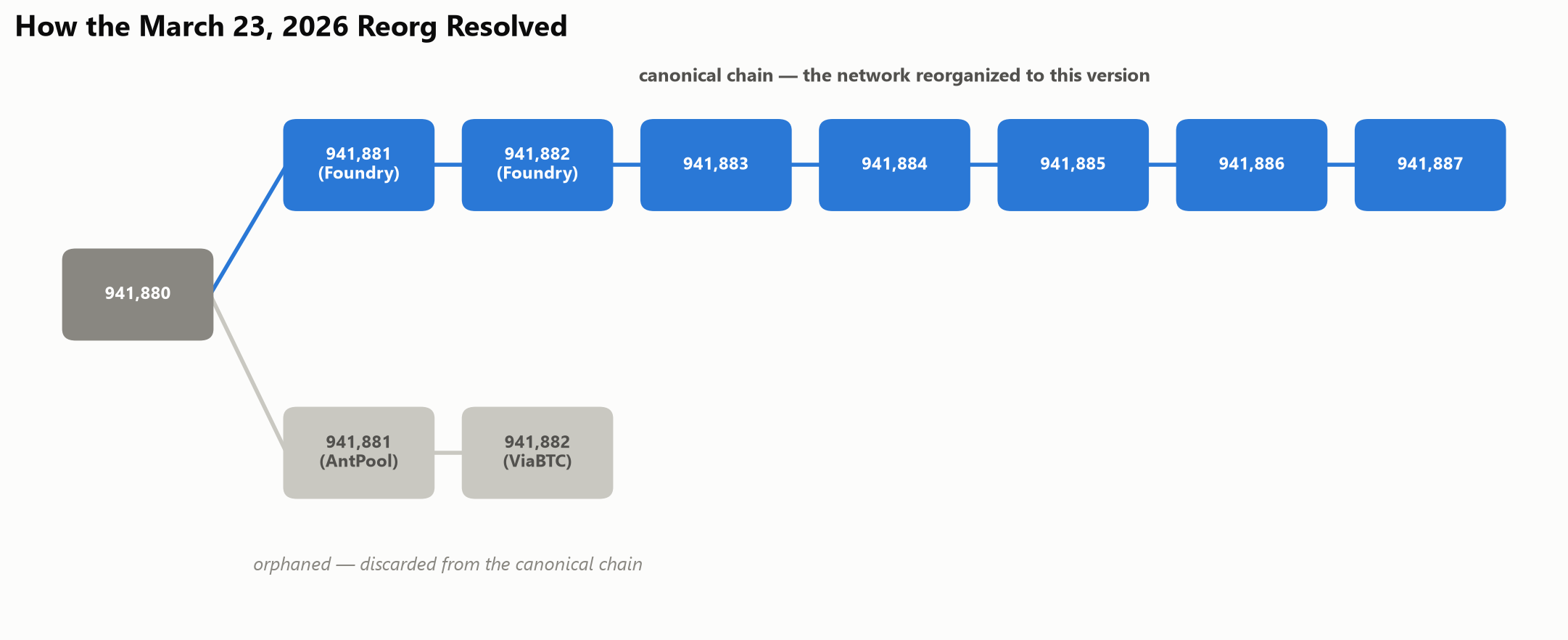
- Antpool and Foundry USA both mined block 941,881 within 12 seconds of each other on March 24, 2026.
- Foundry won by extending its chain six blocks straight, orphaning Antpool’s and ViaBTC’s blocks.
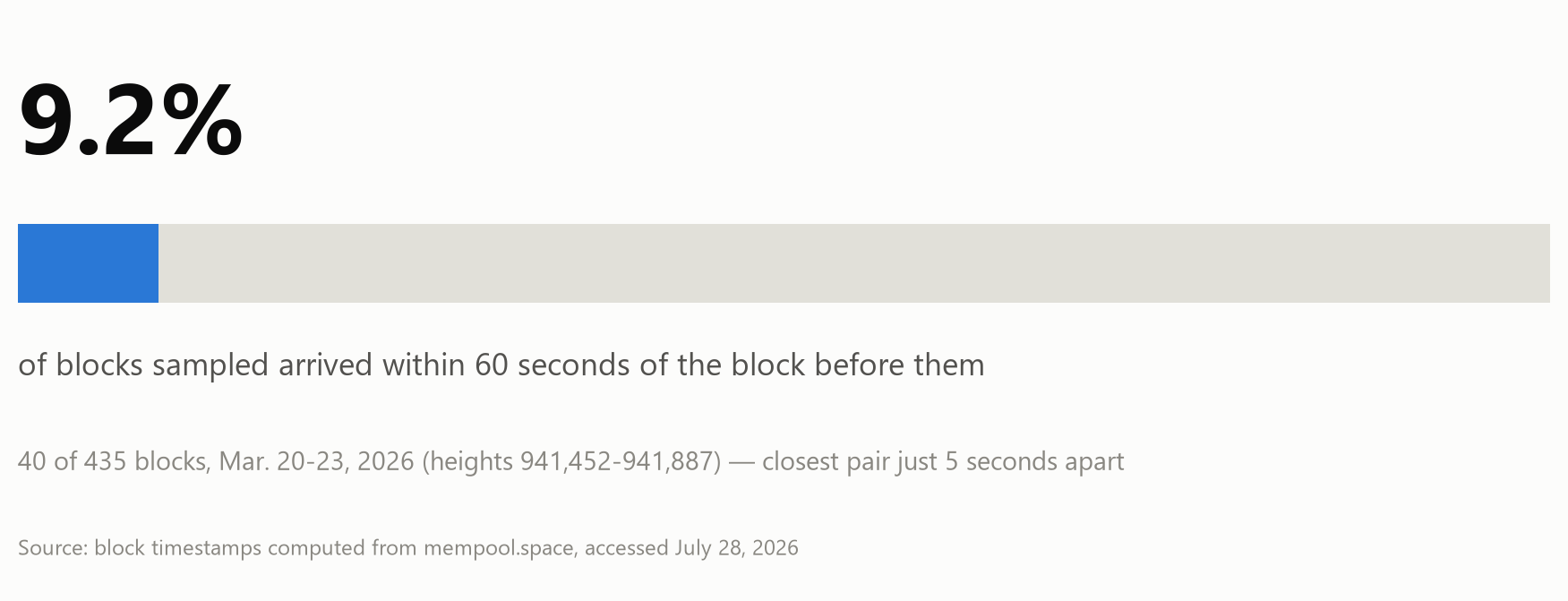
- Data shows 7.3% of blocks over a recent 3-day span landed within 60 seconds of the one before.
Why Two Miners Can ‘Win’ at Once
Bitcoin mining is a race with no referee watching the finish line in real time. A new block has to physically propagate (i.e. hop from node to node) across a global network before every participant agrees on what the current tip of the chain is. That trip takes seconds, sometimes longer on a congested connection.
If a second miner finds a valid block of their own before the first block has finished spreading to them, they build on the version they last saw (usually the previous block) and broadcast their own competing block. For a brief window, two equally valid blocks exist at the same height, each with its own set of confirmed transactions and its own suggestion for what happens next.
Neither block is “wrong” as both satisfy every rule of the protocol; the only thing separating them is timing and which nodes happened to hear about which one first. Roughly half the network ends up mining on top of one candidate, the rest on the other, and Bitcoin briefly has two honest, simultaneous versions of itself.
How the Tie Actually Gets Broken
Bitcoin doesn’t resolve this by vote, authority, or whoever technically found their block first. It resolves it the same way it resolves everything, i.e. whichever chain accumulates more proof-of-work becomes the one every node switches to, and the other side’s block or blocks get discarded.
Discarded doesn’t mean destroyed history was rewritten, but it means that that block, called “orphaned” or “stale,” stops being part of the chain everyone recognizes, and any transactions inside it that weren’t also confirmed on the winning side simply drop back into the mempool to be picked up again in a future block.
Most of the time, this resolves after just one extra block, and nobody outside mining-infrastructure circles notices. A genuine two-block-deep race (where the tie somehow survives an entire additional round without one side pulling ahead) is rare enough to make headlines when it happensprecisely because it requires the coin-flip odds to land the same way twice in a row.
The March 2026 Case: When the Coin Flip Repeated
That’s exactly what happened on March 24, 2026. After Antpool and Foundry USA each produced their own version of block 941,881 twelve seconds apart, ViaBTC extended AntPool’s version with block 941,882 while Foundry, working off its own tip, extended its version too. For one block, the network was genuinely split down the middle between two valid chains. Then Foundry pulled ahead, mining blocks 941,883 through 941,886 in succession (six consecutive blocks on its branch) until its chain was, in the words of one Bitcoin developer tracking the event, “the heaviest by a wide margin.”
Every node reorganized to Foundry’s version, and the blocks AntPool and ViaBTC had mined were orphaned; their miners lost the block reward and fees for that work, though the transactions themselves rejoined the mempool and were confirmed again shortly after.
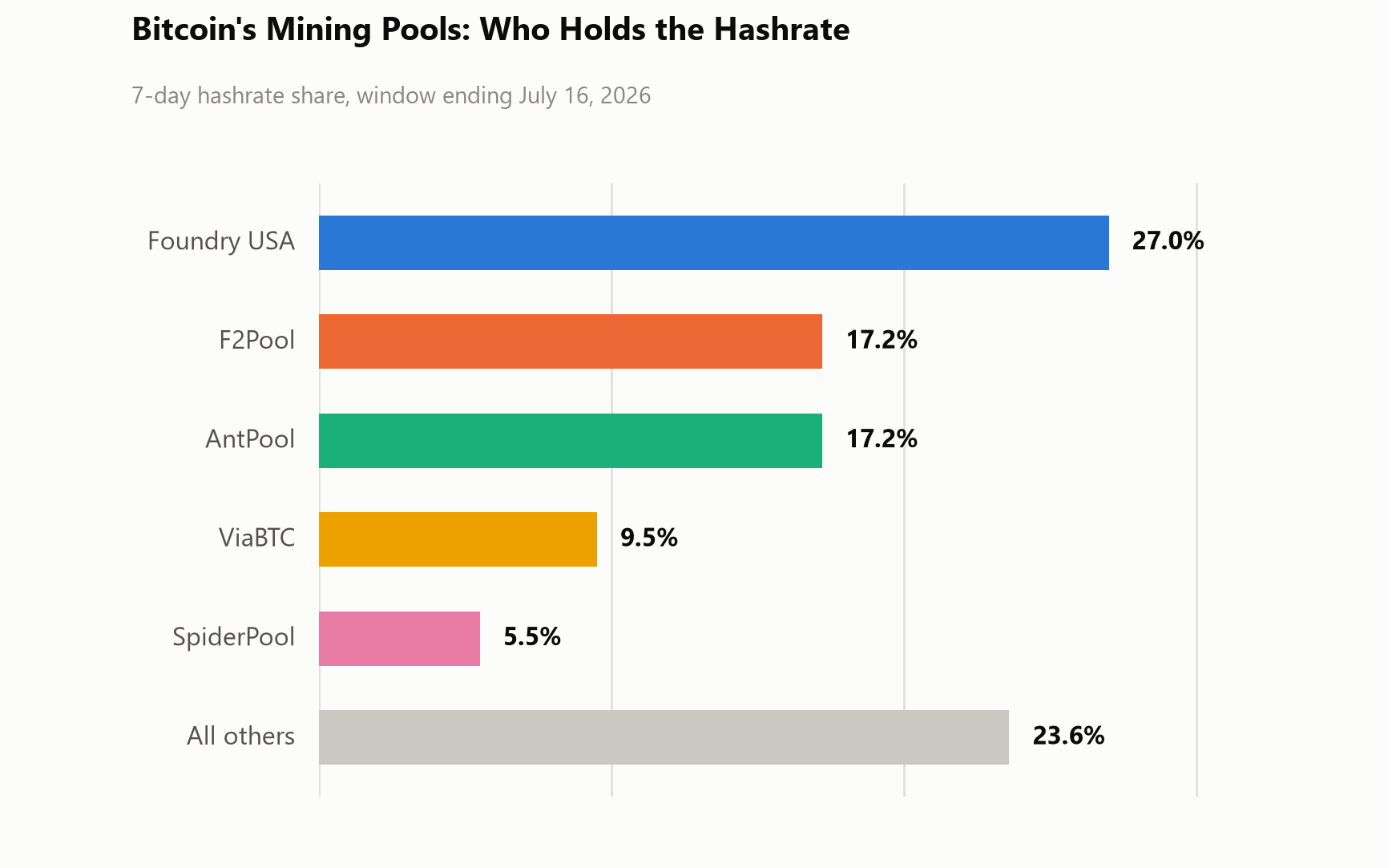
Bitcoin analyst b10c, who first flagged the event publicly, called it “a rare-ish two block fork/reorg between Foundry and AntPool+ViaBTC.” Rare is right, but the event also drew attention to a less comfortable trend, i.e. Foundry stringing together six blocks in a row is easier for a pool that already commands a large share of network hashrate, and coverage of the event noted that shrinking margins have been pushing smaller miners out and concentrating hashpower into fewer, larger pools.
A more concentrated network doesn’t make a single-block race more common, but it does make a well-resourced pool’s odds of winning any given race (and stringing together the follow-up blocks that end one) measurably better than a small miner’s.
The Everyday Version Is Boring, and That’s the Point
Two-block reorgs are the exception; the underlying race condition behind them is not. Pulling real block timestamps directly from mempool.space for the three days before the reorg (heights 941,452 to 941,887), 40 of 435 consecutive-block intervals (about 9.2%) landed within 60 seconds of each other, including one pair just 5 seconds apart. Every one of those close calls is a moment where a genuine race condition, however brief, existed on the network.
Almost all of them resolve within that same single block, silently, because the next miner to find a block overwhelmingly just builds on whichever tip reached them first, and the odds of two ties in a row are long. Compact block relay and dedicated low-latency relay networks like FIBRE, which most large pools now usehave made the propagation delays that cause races shorter than they were in Bitcoin’s earlier years (which is exactly why a race that survives two full blocks, like AntPool and Foundry’s did, is rare enough to be newsworthy rather than routine).
💡 Pro Tip: Bookmark our site for daily insights, market predictions, and expert trading strategies.
🔗 Explore More: Check our sections for in-depth guides, exchange reviews, and blockchain technology deep-dives.