

📰 Exclusive Crypto News & Analysis: Stay ahead with the latest developments in the cryptocurrency and blockchain space.
📈 Market Update: Real-time price movements, technical analysis, and trading signals.
Demand for Shiba Inu is a major issue. Although “buying volume at zero” is not a precise description of the market, current technical and on-chain indicators indicate that significant buying interest has all but vanished, making SHIB susceptible to additional drops. The recent increase in exchange inflows is the most evident cause.
Trillions of SHIB tokens have been moved to centralized exchanges in the past few days. While exchange outflows approached 295 billion SHIB, exchange inflows surpassed 240 billion SHIB. Despite the fact that netflow is still negative overall, the abrupt increase in deposits has sparked worries that large holders are getting ready to sell rather than buy.

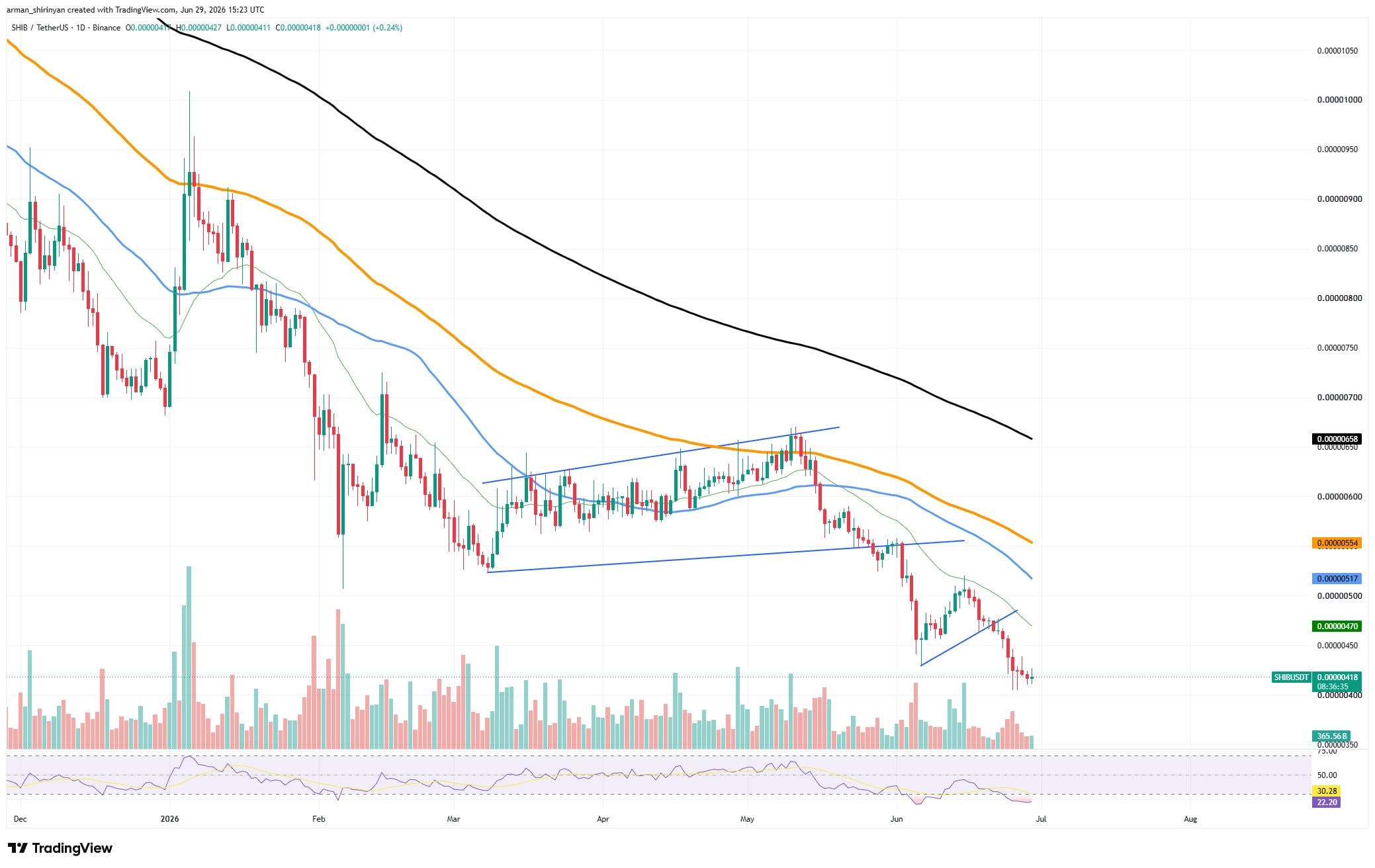
Instead of waiting for sales to happen, traders respond to the potential for future selling pressure. Instead of attempting to catch a falling knife, many investors would rather step aside when billions or trillions of tokens arrive on exchanges. This lack of confidence is reflected in the chart. Since breaking out of a multi-month rising wedge pattern, SHIB has failed all significant attempts at recovery.
Why Shiba Inu (SHIB) Buying Volume Is at 0, Dogecoin (DOGE) Bottom Established, Bitcoin (BTC) Struggles With $60,000: Crypto Market Review
Ripple’s Garlinghouse Slams Strategy’s Financial Engineering
The asset is still trading below its 50-, 100-, and 200-day moving averages, all of which remain in a bearish formation. Due to the fact that every rally has been sold into, buyers are becoming more and more hesitant to enter the market. The lack of speculative momentum is an additional problem.
Historically, SHIB has depended on social media attention, retail enthusiasm, and quick inflows of risk capital. None of those catalysts are present in the current market environment. Meme coins have found it difficult to compete for investors’ attention as Bitcoin, Solana, and other assets draw the little capital that is still entering cryptocurrency markets. It is worth noting that some network metrics are improving.
Over the last 24 hours, there has been an increase in active addresses, active sending addresses, and transaction counts. A recovery narrative would normally be supported by increasing activity. Nonetheless, it seems that investors are more concerned with price action than network usage. Improving on-chain activity is unlikely to alter sentiment as long as SHIB keeps setting lower highs and lower lows.
Dogecoin’s Potential Bottom
It looks like Dogecoin is finally approaching the point where its downward momentum is running out. Several technical signals indicate that DOGE may be forming a local bottom near current levels following months of unrelenting selling pressure and a nearly continuous series of lower highs and lower lows. After going through one of the worst corrections of the current cycle, the meme cryptocurrency is currently trading at about $0.072. With sellers retaining total control over the market, DOGE has lost more than 35% of its value since reaching a peak above $0.11 in May.
The most recent price action, however, suggests that the decline’s intensity may be lessening. The Relative Strength Index is one of the most significant indicators. With its RSI down to about 21, DOGE is firmly in oversold territory. In the past, readings below 30 have been indicative of severe selling pressure.
You Might Also Like


Oversold conditions frequently precede periods of stabilization or relief rallies, but they do not by themselves ensure a reversal. The gap between the current price and major moving averages is another positive indicator. At the moment, DOGE is trading well below its 50-, 100-, and 200-day moving averages. Such dislocations seldom last forever. Over time, markets typically return to their averages, particularly following protracted episodes of panic selling.
The potential for a bottoming process is further supported by volume dynamics. The explosive selling volume that marked previous breakdowns has not coincided with recent declines. This implies that there may be less immediate selling pressure, as many weak hands may have already sold their positions. Nevertheless, it would be premature to declare a complete trend reversal.
The overall market structure is still negative, and DOGE is still below all significant resistance levels. Regaining the 50-day moving average around $0.083 would be the first obstacle facing bulls. The 100-day and 200-day moving averages at $0.093 and $0.11, respectively, would become significant barriers above that.
Bitcoin Is Back in the Trading Range
One of the most significant psychological levels in the cryptocurrency market is being tested once more by Bitcoin. Following weeks of intense selling pressure, Bitcoin has returned to the $59,000–$60,000 range, where bulls are trying to avert another significant collapse. The technical picture is still very bearish, which is the concern.
Recently, an upward trendline supporting the April–May recovery rally in Bitcoin was lost. The sharp selloff that ensued throughout June was made possible by the breakdown, which signaled the end of the medium-term uptrend. Every attempt at recovery since then has been met with fresh selling pressure.
You Might Also Like

At the moment, Bitcoin is trading below its 50-, 100-, and 200-day moving averages. While the 100-day and 200-day averages, at roughly $69,000 and $76,500, respectively, remain significantly above current prices, the 50-day EMA near $63,700 has emerged as the first significant resistance level.
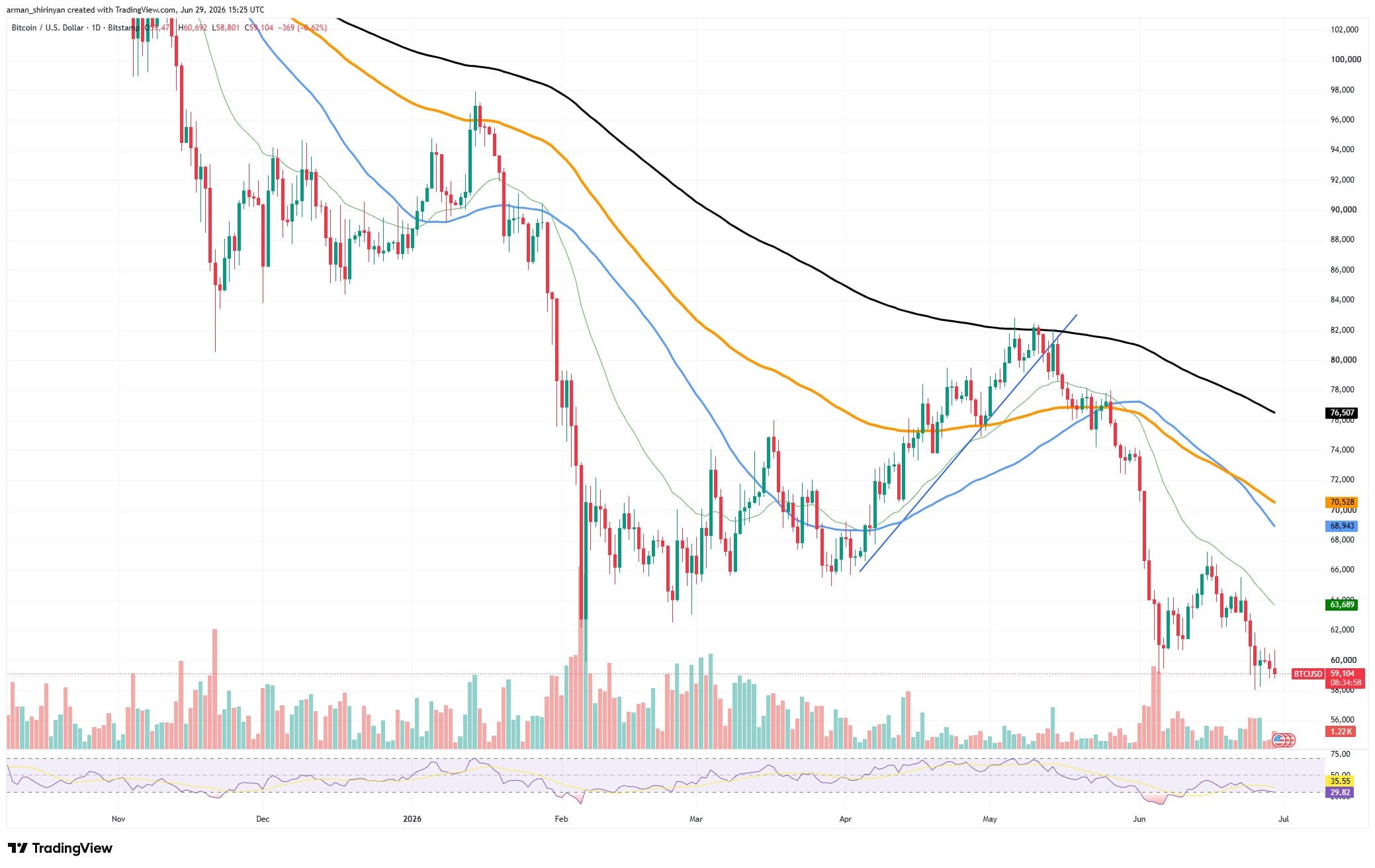
This alignment demonstrates that sellers continue to dominate the overall trend. The $60,000 threshold has become a battlefield. Traders and institutions have historically paid close attention to round numbers, and Bitcoin is no different. Although buyers have so far managed to avoid a clear breakdown below this level, support is eroding with each retest. Momentum indicators are sending conflicting signals. With the RSI declining toward 30, Bitcoin is now close to being oversold.
This raises the likelihood of a relief rally and implies that selling pressure may be running out in the near future. Oversold conditions, however, frequently persist longer than traders anticipate during severe downtrends. Volume remains a concern. Elevated selling activity has coincided with recent declines, suggesting that market participants are still reducing exposure rather than actively accumulating.
Bulls’ immediate goals are straightforward: protect $60,000 and push Bitcoin above the 50-day moving average. A more extensive rebound toward the $69,000 area could be sparked by a successful move above $64,000. However, the market may experience another wave of liquidation pressure if support fails. In that case, as traders look for the next significant support zone, Bitcoin would likely enter a new stage of price discovery to the downside.
💡 Pro Tip: Bookmark our site for daily insights, market predictions, and expert trading strategies.
🔗 Explore More: Check our sections for in-depth guides, exchange reviews, and blockchain technology deep-dives.